RYF-001 / shapes maketh aim — 01
A shape decides an allocation, not a grip
Where the design of RYF-001 begins. What a mouse shape decides is not how you hold it, but an allocation: which movements of the hand are held still, and which are left free.
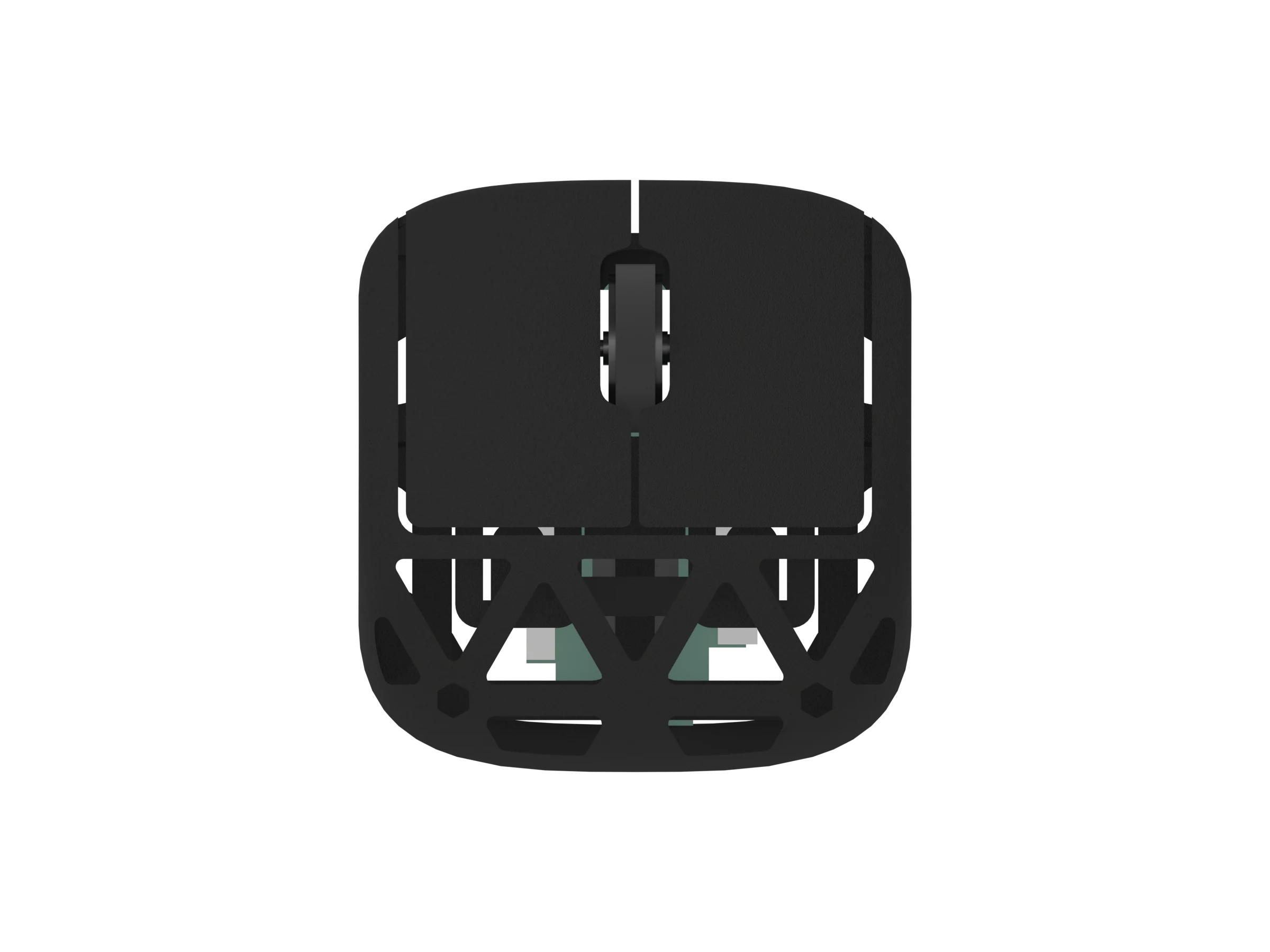
Question
What will decide how a gaming mouse feels to use from here on?
Background
Today’s gaming mouse market is full of products built on shapes that were popular in the past. Products whose shape is designed from a genuinely new line of thinking are surprisingly rare.
Worse, some makers copy, as closely as they can, a shape another company spent a long time developing, and sell it as their own flagship. The shape is the part of a mouse where the designer’s thinking shows most. Can a product that borrows that part from someone else, however good its spec sheet, ever answer the question “why this shape?” in its own words?
Meanwhile, the electronic specifications — sensor performance, polling rate, wireless performance — have improved rapidly with advances in semiconductor technology. The gap between high-end products is becoming small.
Once the specs have converged, what separates one experience of using a mouse from another? I concluded that one answer is the shape.
Design intent
Rethinking how grip and shape relate
The shape of a mouse and the way it is held are closely related. But I think we have misread that relationship for a long time. The classification “small mice for fingertip, large mice for palm” is an extension of the idea that the shape decides the grip.
Here I want to change the point of view at the root.
Whenever a person does precise work with the fingertips, something nearby is always held steady — the same way the little-finger side of your palm rests on the paper when you write. Without a support point close to the part that moves, fine movement actually becomes harder. This is not specific to mice; it is a principle shared by every kind of precise work.
The hand does not move as one block
From this point of view, it becomes clear that the movement of the hand is a collection of several separate movements.
| Movement | What it is |
|---|---|
| Fingers, vertical | Bending and straightening |
| Fingers, lateral | Spreading and closing |
| Wrist | Extension and flexion |
| Palm | Sliding fore and aft |
Each of these can, in principle, be moved independently.
A grip is a difference in allocation
The difference between grips is nothing other than a difference in allocation: which of these movements are fixed as support points, and which are left free.
- Palm: the whole palm fixes many movements, and aim comes from large movements of the wrist and arm
- Claw: only the lateral movement of the fingers is fixed; vertical bending and straightening are left free
- Fingertip: almost nothing is fixed, and the mouse is supported by the free movement of the fingertips alone
What a shape decides first is not the grip itself. It decides an allocation: which movements are fixed and which are left free. The position the hand settles into is the result, and only afterwards do we give it a name like palm, claw or fingertip.
In fact, the same person will unconsciously change how they hold a mouse when its shape changes. Rather than users choosing a mouse to suit their grip, the shape guides the grip through its allocation. And that allocation keeps affecting not only how the mouse feels the moment you pick it up, but the aiming itself, from then on.
Where RYF-001 begins
So RYF-001 does not start from the shape of an existing product. The shape is designed backwards from the allocation itself: which movements should be supported, and which should be left free.
Next, in shapes maketh aim — 02, I write about why, looking across the grips from the point of view of allocation, I chose the fingertip hold first.