RYF-001 / shapes maketh aim — 02
Why I started from the fingertip hold
Can stable aim exist in the grip with the least support? Why RYF-001 chose the fingertip hold, and the stabilising work that falls on the muscles as the price of its freedom.
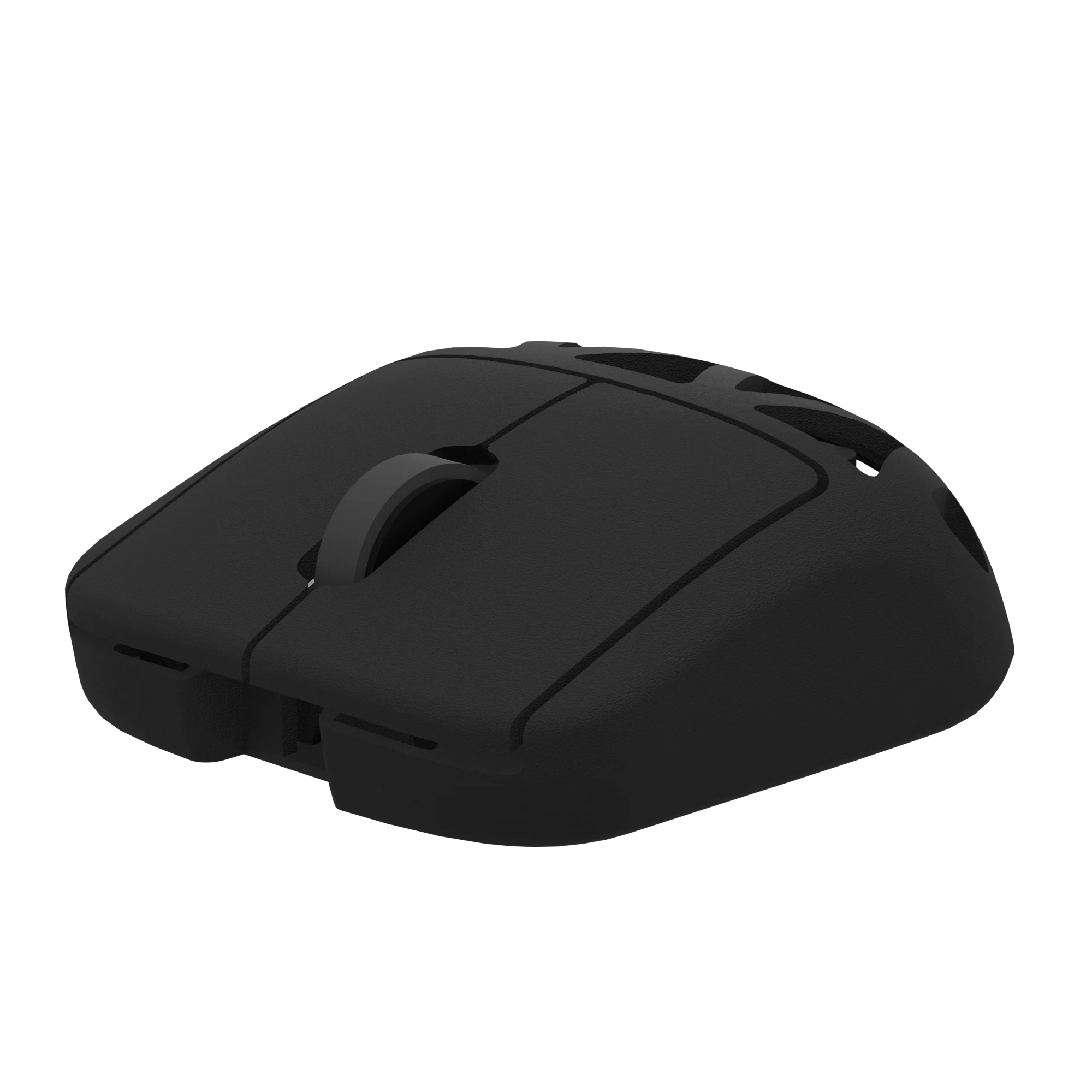
Question
Can stable aim exist in the grip with the least support?
Background
I am not a fingertip user
I should say this first: I do not use a mouse with a fingertip hold myself.
Even so, the fingertip hold interested me a great deal. Almost nothing holds the hand in place. In other words, its allocation of freedom is extremely lopsided. Under this unusual condition, which no other grip shares, can truly stable aim exist? That single question was where it all started.
Is “narrow and small” really the best answer?
Out of that interest, I looked across the fingertip mice on the market today. I noticed that almost all of them give only one answer: make the mouse narrow and small so the fingertips can manage it.
Is making it narrow and small really the answer that logically draws out the fingertip hold’s advantage, its high degree of freedom? I felt that existing products had not yet properly answered the essential problem I described last time — how to provide a support point.
Precisely because it is the most lopsided allocation
In theory, too, the fingertip hold is the most lopsided allocation of all the grips. Compared with palm and claw, almost no movement is fixed; the mouse is supported with nearly everything released.
That is exactly why I thought the fingertip hold was the sharpest place to take on the problem of redesigning the allocation.
An interest in how little is fixed, a doubt about the design thinking behind existing products, and a theoretical point of view. Where these three overlapped, RYF-001 began as a model dedicated to the fingertip hold.
What a fingertip hold offers
The defining feature of a fingertip hold is that, on top of the shoulder, arm and wrist, it actively uses the fingers themselves to move the mouse.
In palm and claw grips, the position of the hand relative to the mouse is fairly fixed. In a fingertip hold the palm is not fixed to the mouse, so the mouse can move freely within the hand. That freedom pays off wherever fine input is needed:
- Fine aim adjustment on a headshot
- Aiming at small, distant enemies
- Pixel-level angle adjustment
- Small corrections during recoil control
- Tracking targets that move in three dimensions — up, down, left and right
The aim can be corrected by moving the fingertips slightly, without large arm movements. This is a major advantage that belongs to the fingertip hold.
The cost of a fingertip hold
That high degree of freedom, though, carries a cost that cannot be overlooked.
As I wrote last time, precise work needs a support point nearby. In palm and claw grips, the shape provides that support point — through the broad surface of the palm, or by fixing the fingers laterally. A typical fingertip hold holds the mouse only through a few fingertip contacts — the thumb, ring finger and little finger — and leaves almost every movement free.
Since the shape does not provide a support point, that role is taken over by the muscles of the fingers and forearm. This is why the mouse tends to shift slightly in the hand during play, and why the fingers tend to apply more force than necessary to stop it. As a result, problems like these can occur:
- The fingers tire over long sessions
- The load concentrates on the thumb, ring finger and little finger
- The forearm tends to tighten
- You grip the mouse hard without meaning to
- The same hold is hard to reproduce consistently
As I see it, the fingertip hold is “a grip that gains a high degree of control freedom, at the price of easily putting the stabilising work needed to keep that freedom onto the user’s own muscles.”
Design intent
RYF-001 does not aim to take away the freedom of the fingertip hold.
To have the shape take on the stabilising work that would otherwise fall to the user’s muscles.
That is the design goal of RYF-001.
Next, in shapes maketh aim — 03, I write about RYF-001’s first answer to this goal: why a mouse for the fingertip hold was deliberately made wider.