RYF-001 / shapes maketh aim — 04
Three freedoms left open — waist, flank angle, front
Sharply flared sides, and recessed clicks. What two rejected ideas made clear about where the design stands: it optimises an allocation; it does not prescribe a right answer.
Question
Once the shape takes on one movement, how should the rest be treated?
Background
Last time, RYF-001 used its width to have the shape take on the lateral drift of the fingers.
The thing to be careful of here is that the more the shape supports, the more freedom the user loses. Stopping lateral movement does not justify binding the other movements with the shape too; that would take away the very freedom of the fingertip hold.
Of the four movements listed in part 1, three remain: the palm sliding fore and aft, the angle of the fingers — upright or laid flat — and the vertical bending and straightening of the fingers.
In fact, partway through the process I did build versions in which the shape decided some of these.
Prototypes and method — two ideas tried and rejected
Sharply flared sides
One gave the sides an extreme flare (seen from the front, sides that open outward toward the top).
In the hand, it made the already wide body feel wider still. The bigger problem was the feeling that the finger angle was fixed too firmly. Against the concept of letting the width open the fingers naturally, this version forced the fingers into an open position.
Recessed clicks
The other deliberately recessed the click surfaces.
The aim was to show fairly clearly, from my side, the right place to press the clicks. But like the sharply flared sides, this too restricted freedom more than necessary.

V1

V2

V3

V4

V5

Final
Design intent
Optimising an allocation, not prescribing a right answer
Rejecting those two ideas made clear where the design of RYF-001 stands.
What the shape does is optimise an allocation — nothing more. It does not prescribe a right answer.
A single question can have more than one answer, more than one interpretation. And I believe those are for the user to find. At what angle to place the fingers, where to press, where on the mouse to hold it. The shape decides only which movements to support and which to release. Beyond that, it is left to the hand.
With that thinking, the remaining three movements were treated as follows.
No waist — freedom fore and aft
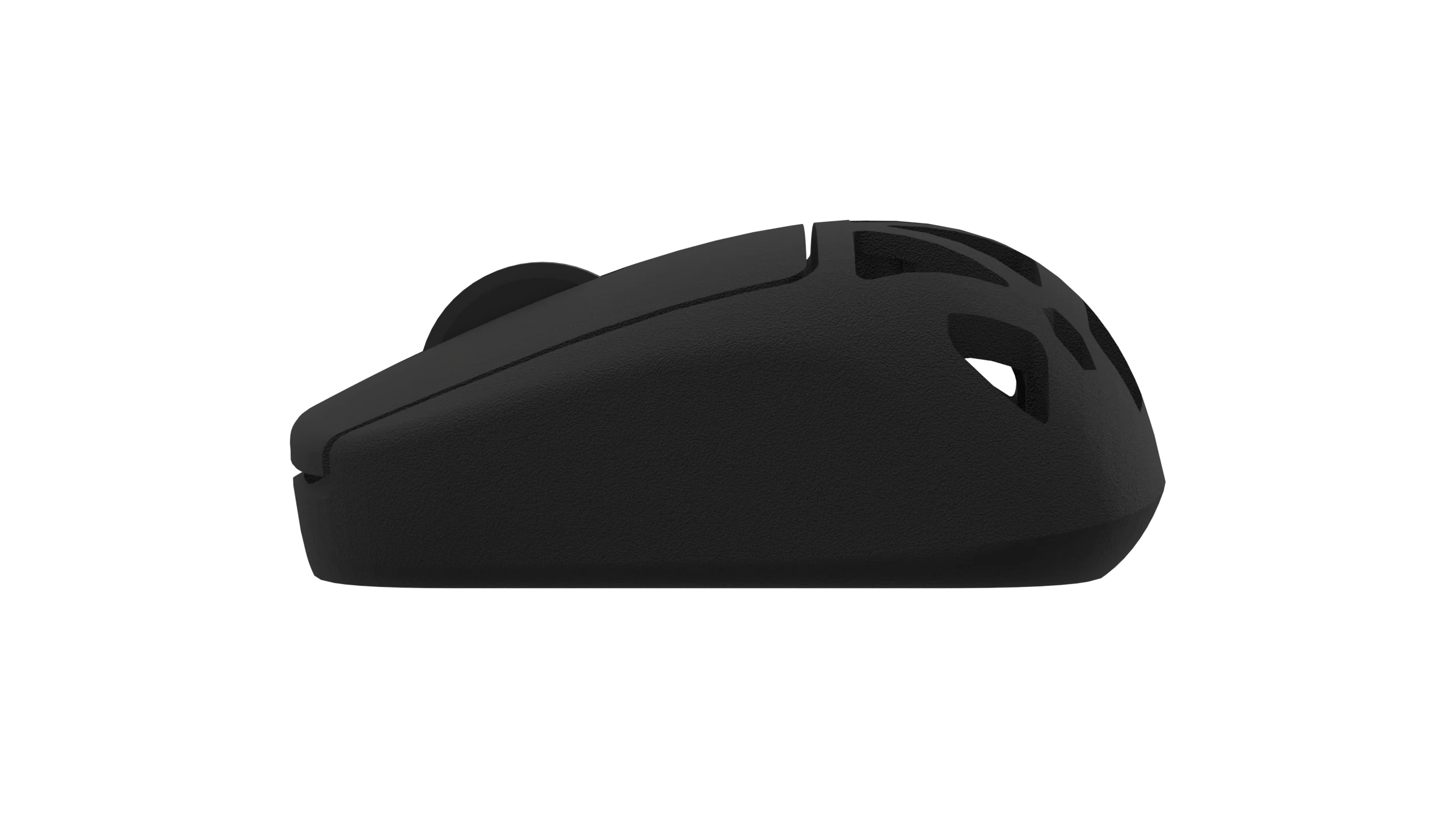
The flanks of RYF-001 deliberately have no waist, the pinch commonly seen on gaming mice.
A waist guides the fingers to a particular gripping position. Once the gripping position is set, the freedom to slide the palm fore and aft narrows. A waist is a shape that shows the “right” place to grip.
Holding the mouse a little further forward. Holding it further back. Shifting it fore and aft within the hand during play. The shape is meant not to constrain these movements, which are particular to the fingertip hold. Being able to hold it naturally at any fore-aft position was the condition for not undermining the fingertip hold’s advantage: that the mouse can move freely within the hand.
A flank angle that does not dictate — freedom of finger angle
After rejecting the sharply flared sides, I kept the slope of the flanks within a range that is not extreme.
The width already does the work of stopping lateral drift. Dictating the flank angle firmly on top of that would take away another freedom — whether to hold with the fingers upright or laid flat. The flanks are made to suit a range of fingertip holds, from people who stand the ring and little fingers up to people who lay them flat.
A low front — vertical response
The front is designed as low as possible.
What is at stake here is the vertical bending and straightening of the fingers — the response of clicks and small corrections itself. By reducing the distance between fingertip and mouse and keeping the mouse’s presence as small as possible, I aimed for a feel in which hand and mouse move as one, rather than the mouse following a moment behind.
Across the width I built in resistance to stop drift; here, by contrast, I built in none. Nor are the clicks recessed to show where to press. Passing the movement of the fingers through as directly as possible comes first.
Summary — one taken on, three left to you
| Part | Movement it relates to | How RYF-001 treats it |
|---|---|---|
| Width | Lateral spreading and closing of the fingers | Taken on by the shape |
| Flanks with no waist | Palm sliding fore and aft | Left free |
| A flank angle that is not extreme | Fingers upright or laid flat | Left to the user |
| Low front | Vertical bending and straightening of the fingers | Passed straight through |
Width, the waist of the flanks, the flank angle, the height of the front. Each of them sits within one continuous design policy: which movements the shape takes on, and which it leaves to the user’s freedom.
Next, in shapes maketh aim — 05, I write not about the shape but about what I only learned by actually using it.