RYF-001 / shapes maketh aim — 06
30 g without added reinforcement
The first internal structure, with no ribs, flexed the moment force went in. How rib placement and separate click plates gave the housing its own rigidity, without adding a reinforcing part.
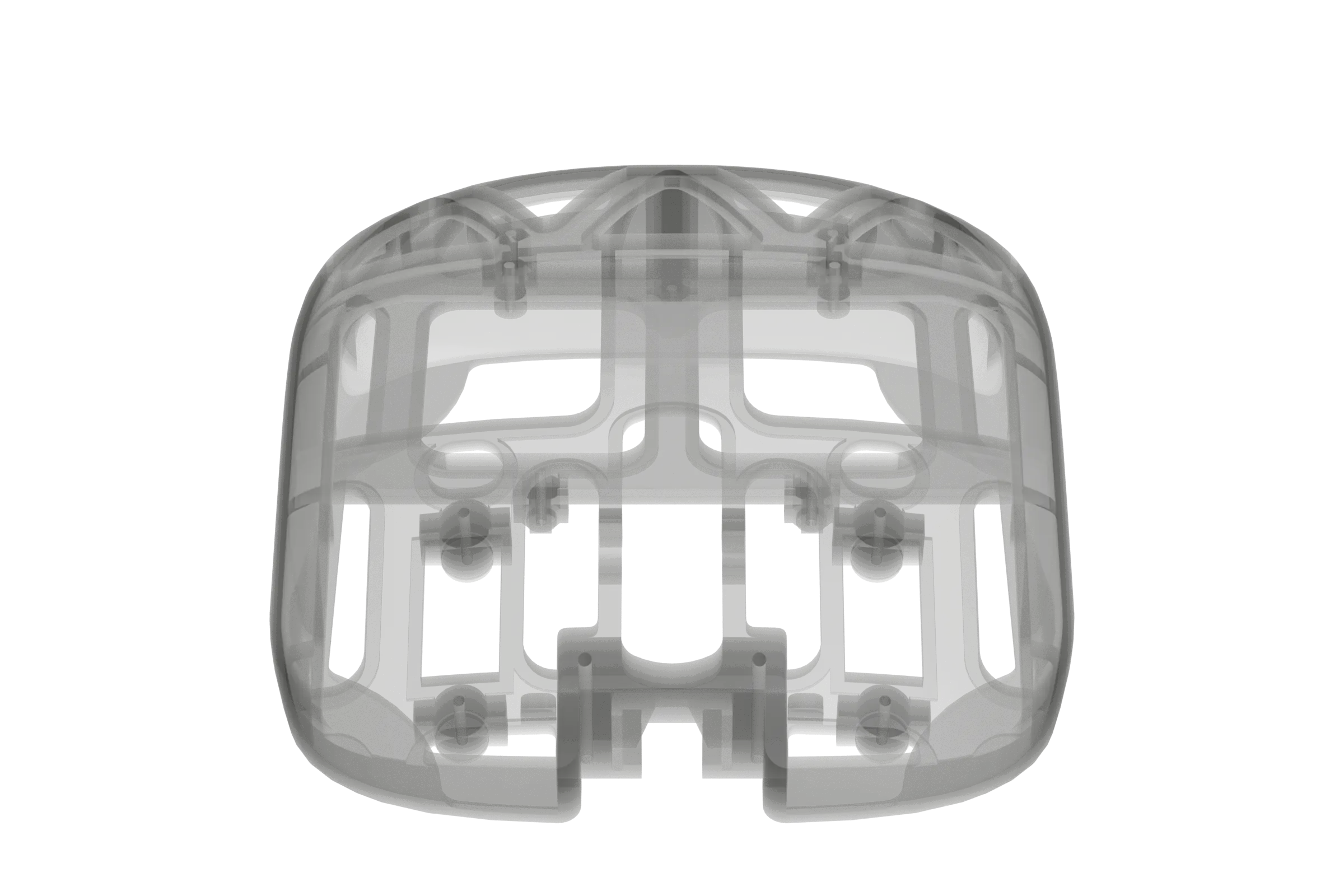
Question
Can lightness and rigidity coexist without adding a reinforcing part?
Background
Some recent ultralight gaming mice secure their rigidity by placing a metal frame or a separate reinforcing part inside, apart from the shell. It is certainly an effective way to combine low weight with rigidity.
But low weight and rigidity naturally pull against each other.
- Thicker walls raise rigidity, and add weight.
- Thinner walls, for the sake of lightness, bring flex and creak when you grip.
The first internal structure, and where it failed
Not a single rib
The first internal structure was nothing more than posts running straight to the screw holes. There was not one internal rib. The clicks were also made in one piece with the shell.
Flexing the moment force goes in
Using this prototype, I could feel the housing distort when I tensed for a sudden flick, or when I clicked. The click feel had gone wrong as well.
A distortion that is hard to notice in normal use and appears only at the moment force goes in. But that moment is precisely when aim demands the most precision.
Design intent
Placing optimally, not simply adding
There were two options here: add a reinforcing part, or rethink the structure itself.
RYF-001 took the second. I rebuilt the internal structure from scratch and switched to a policy of securing the rigidity it needs from the structure of the housing itself.
Two things were revised.
- Rib placement: where load is applied when you grip, flick and click, and how that force travels. With that in mind I placed ribs inside, putting material efficiently where it is needed.
- Separate clicks: the clicks, one piece with the shell in the prototype, became separate parts. This keeps the force of pressing a click from travelling as distortion through the whole housing, so the click feel does not depend on the housing flexing.
The result is rigidity that resists flexing even under a hard grip, at a weight of about 30 g, measured.

Early (no ribs)

Final (ribbed)
Reducing weight is not only removing material
Reducing the weight of RYF-001 did not simply mean cutting material away. It meant putting the necessary structure where it is needed, and thoroughly stripping away everything else.
This is exactly the same thinking as the design of the exterior. On the outside, the width takes on lateral drift and every other movement is left to the user. On the inside, ribs go where load is applied, and material is taken out everywhere else.
Where to give a role, and where to release. From the visible form to the unseen internal structure, RYF-001 is designed around this one question.
Closing the series “shapes maketh aim”
Over six parts, I have written about the design of RYF-001.
- What a shape decides is not the grip, but an allocation: which movements are fixed and which are left free.
- I chose the fingertip hold, the most lopsided allocation, and set the goal of having the shape take on the stabilising work the muscles had been doing.
- Comparing prototypes of different widths in the hand, I learned that narrowness stiffens the muscles, and made the mouse wider.
- I rejected the ideas that prescribed a right answer, and left fore-aft sliding, finger angle and vertical response to the user.
- By using the prototypes, I found problems with the board angle and the sensor height that were invisible in CAD.
- From the flex of a structure with no ribs, I separated the clicks and secured rigidity from the structure of the housing itself, without adding a reinforcing part.
The shape does not decide the grip. The shape designs how aim moves, and the grip follows from it. That one point is everything RYF-001 sets out to embody.
shapes maketh aim