RYF-001 / shapes maketh aim — 03
Making it wider — inverting the rule
Holding prototypes of different widths side by side showed that narrowness was stiffening the muscles and taking freedom away. Why RYF-001, a fingertip mouse, was deliberately made wider.
Question
Should a mouse for the fingertip hold really be narrow and small?
Background
Most of the small, light mice described as fingertip mice are made narrower than a typical gaming mouse so the fingertips can manage them.
As I wrote last time, a typical fingertip hold leaves almost every movement free, including the lateral movement of the fingers. With that much freedom, the work of stopping drift falls on the muscles of the fingers. That leads to fatigue and tension over long sessions.
Prototypes and method
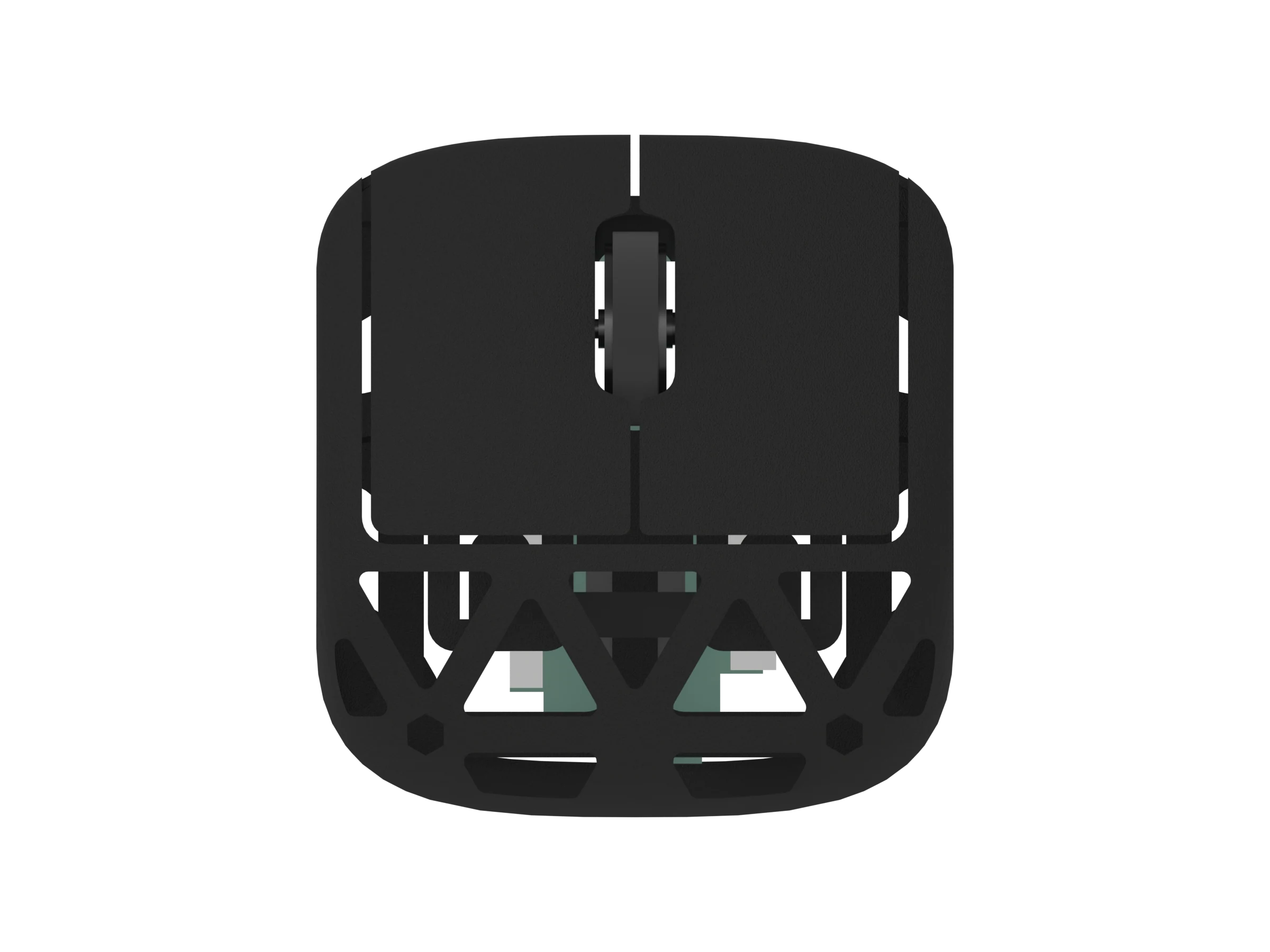
I worked out the shape of RYF-001 by printing more than six versions on an FDM 3D printer. Width was one of the variables: I made several prototypes of different widths and compared them in the hand.
Length was varied alongside width: the early V1 and V2 were made longer than the final form.

V1

V2

V4

V5

Final
Observations
Holding them side by side, the narrow prototypes felt, at first, as if they gave more freedom. They could be pinched lightly with the fingertips and seemed easy to move in any direction.
Looked at against the theory, though, it was the other way round. On a narrow mouse, the fingers pinching from either side sit close together. The mouse then moves sideways with even a slight change in force, and becomes unstable. To hold that instability down, the finger muscles stay constantly stiff.
The narrow mouse looked as if it gave freedom, but in fact it stiffened the muscles and took freedom away.
That was the biggest finding from comparing them in the hand.
Comparing them in the hand said something about length too. The long V1 and V2 were long enough for the fingertips to reach both the clicks and the flanks. In practice, though, they tended to be held with the fingers stretched out, which took away the fingers’ vertical freedom. The rear also met the palm and became a pivot, and the contact area came close to that of a claw grip. A fingertip grip holds almost nothing still; an unintended hold had been added to it.
Length also got in the way of shifting the mouse forward and back in the hand. Lifted, it felt as if it carried more inertia, with its centre of mass further from the fingertips, and it was harder to handle.
Design intent
Inverting the rule
RYF-001 inverts the idea of making it narrow. It is designed wider than a typical gaming mouse.
This is not because I simply wanted to make a wide mouse. The width is there to hand the work of stopping lateral drift from the finger muscles to the shape.
Opening the fingers so drift is less likely to start
When the mouse is wider, the thumb, ring finger and little finger open outward naturally. Held with the fingers moderately open, the fingers are less likely to move too far sideways during play, without any need to tense them.
This is not about stopping drift with muscle once it has started. The shape creates a state in which drift is less likely to start at all. Because the muscles no longer have to stiffen, the fingers regain the freedom they were meant to have.
Only one thing is fixed
This approach is close to the idea behind the claw grip, which fixes only the lateral movement of the fingers and leaves vertical movement free.
Of the four movements listed in part 1, the width of RYF-001 fixes only the lateral movement of the fingers. The fingertip hold keeps its advantage of free fingertip movement, and just one movement that had too much freedom is settled by the shape.
It is RYF-001’s own answer, different from the conventional idea that fingertip mice should be narrow and small.
Length: the shortest the insides allow
While the width went up, the length came down. The final length is the minimum set by where the board and the sensor sit.
Being shorter, it can be held without stretching the fingers, and the rear no longer meets the palm as a pivot. It does not get in the way of shifting the mouse forward and back in the hand. In weight too, the shorter body contributes to the measured weight of about 30g.
Trade-offs
To someone used to narrow mice, it may feel large at first. Even so, RYF-001 put not making the finger muscles stop the drift ahead of looking easy to handle.
Next, in shapes maketh aim — 04, I write about the three movements RYF-001 deliberately left unconstrained by the shape, while fixing the lateral one.